

Taoism Three Treasures

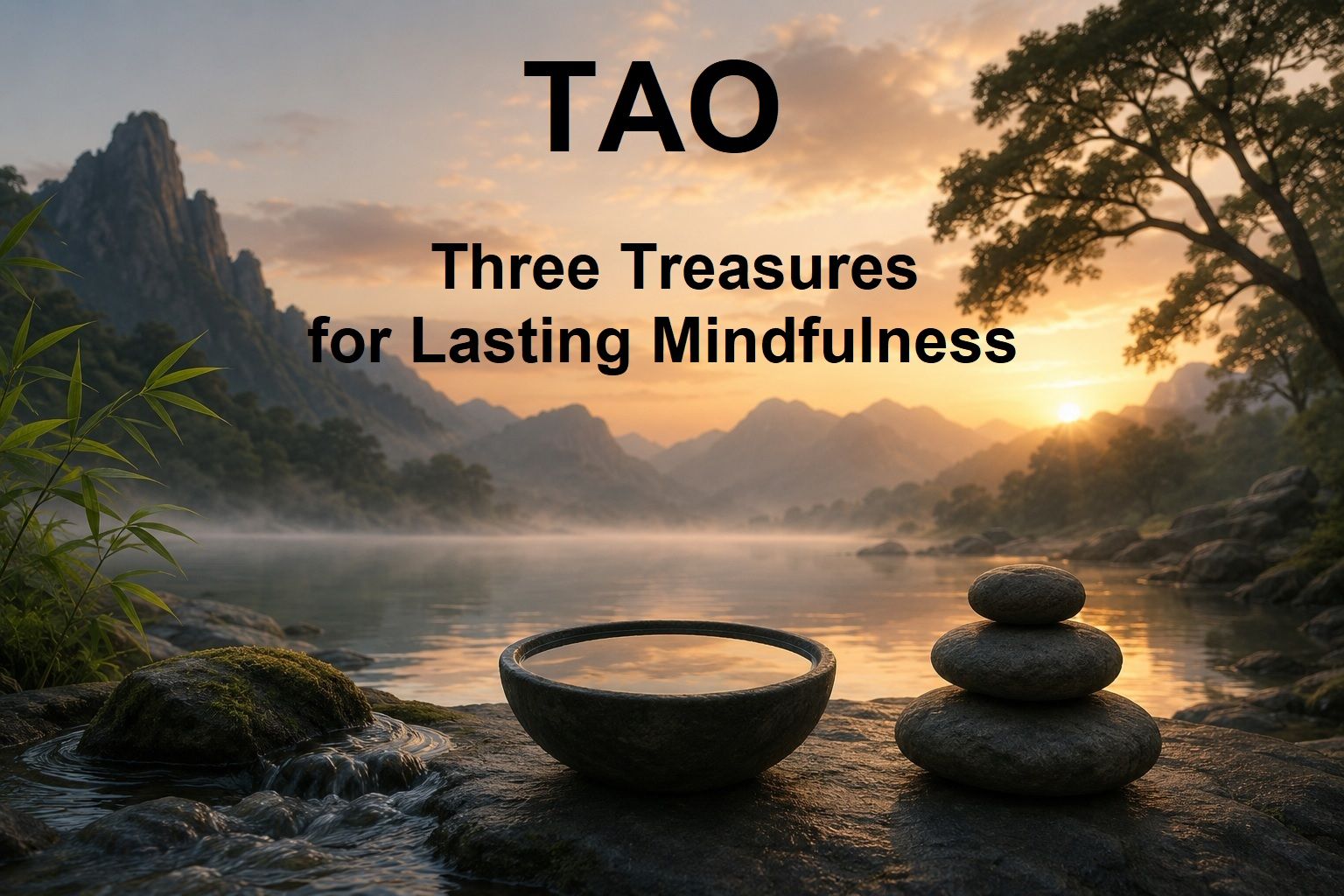
Tao te Ching Chapter 67
“I have three treasures,
which I hold and protect:
The first is called compassion;
The second is being malleable like an uncarved block;
The third is not daring to take the lead in the empire.”
More than any other approach to mindfulness, cultivating Taoism’s three treasures provides a lasting practice that centers us in the moment. Each fortifies the other in a way that embracing all three creates the perfect container to live joyfully.
First Treasure: Compassion
Perhaps we have experienced how holding onto a grudge only weighs us down. We give nothing away when we forgive someone—we give to ourselves by releasing the burden.
But the compassion we cultivate as the First Treasure is something that would make forgiveness irrelevant.
It is not an adjustment of perspective; it is a liberation from the illusion of separateness. Like the idea behind 'namaste where we honor another as ourselves,' the moment we recognize this connection in all we see, the walls that confined us begin to dissolve.
We often imagine forgiveness as something we extend to others. In truth, it is what releases us from the burdens of resentment, fear, and isolation. Compassion does not merely change how we see the world—it changes the world we inhabit.
Through compassion, we can release the hold the past has on us to fully participate in the moment.
Compassion is not a kinder opinion. It is a homecoming. It is the quiet realization that the boundaries we defend are unnecessary, and that freedom begins the moment we no longer carry the weight of our passing judgments.
Meditation: Nothing separates me from the world that flows around me.
Second Treasure: The Uncarved Block
Compassion becomes effortless when we begin to detect the malleable and ever-changing aspect of life that is always in motion. Observing each experience as an uncarved block makes judgment dissolve like the icy landscape of spring.
Life is not a collection of fixed identities but an unfolding process of becoming. Every person is shaped by countless influences—genetics, experience, culture, relationships, chance, and the invisible currents of a changing world.
No one arrives fully formed, nor remains unchanged. Everything we see is in a motion of becoming.
When we truly understand this, judgment begins to lose its certainty. It becomes difficult to condemn another as though they were a finished object rather than a life still unfolding.
We recognize that every action emerges from conditions we only partially understand, and every person carries the possibility of becoming something new.
This does not excuse harmful behavior or erase accountability. Rather, it transforms the spirit in which we respond. We no longer meet others with the rigid certainty of condemnation, but with the humility of knowing that we, too, are shaped by forces beyond our complete awareness.
Just as natural disaster renew the Earth. what appears as conflict often emerges to set us free.
Compassion grows from this realization—not as an act of mercy, but as an expression of truth.
To witness life as an ever-changing process is to discover that compassion is not sentimental. It is the natural response to a world where nothing is static, no one is finished, and every moment holds the possibility of transformation.
If reality is an ongoing process of emergence rather than a collection of fixed things, then compassion is not simply an ethical choice—it is the most accurate way of allowing life to finish its work.
Meditation: There is nothing to cling to when I am part of this flow of becoming something more.
Third Treasure: Not Taking the Lead
We can see how mindfulness blossoms when we honor life’s malleability and observe with compassion.
The third treasure is humility—the quiet understanding that we are a guest here, not the host. We did not create this living world, nor do we command its unfolding. We belong to it, participate in it, and are sustained by it, but we do not stand above it.
Much of our suffering comes from mistaking participation for control, believing that if we plan carefully enough, resist fiercely enough, or worry deeply enough, we can secure an uncertain future.
Yet control is often an illusion born from fear. Fear rarely lives in the present moment. It reaches for us like an illusion, imagining losses that have not occurred, rehearsing futures that may never arrive, and trying to shape what remains unknowable.
The universe remains unknowable for a reason—it keeps us growing and ensures that anything is possible. Life is always happening here, while fear is usually living somewhere else.
To recognize ourselves as guests is not to become passive. It is to exchange the exhausting burden of control for the quieter wisdom of honoring the path and learning to follow.
We respond rather than react. We cooperate rather than dominate. We trust that, like every living thing, our lives are carried by forces larger than ourselves.
Meditation: In the present, there is only this breath, this step, this conversation, this unfolding moment.
Together, these three treasures become a foundation for mindfulness as a lasting outlook. Wonder opens us to the mystery of existence, reminding us that life is richer than our explanations.
Compassion frees us from our judgments of the past, revealing that every person, including ourselves, is part of an ever-changing process of becoming.
Humility dissolves the illusion of control, allowing us to meet the present without being consumed by imagined futures.
When woven together, wonder, compassion, and humility return us to our rightful place within the living world. They quiet the restless mind that seeks certainty, soften the heart that seeks division, and loosen the grasping hand that seeks control.
In their place arises a deeper awareness—one that does not stand apart from life, but moves with it.
And perhaps this is what mindfulness has always been: not the mastery of the mind, but the willingness to participate fully in the unfolding mystery of being alive.
“Everyone in the world says that my Tao is vast
and resembles nothing.
It is because it is vast that it
resembles nothing; if it resembled anything
it would have, long ago, become small.”